Ring Four — Wind: Knowing the Other Schools
In Musashi's framework, Wind is the ring of understanding other traditions — not to imitate or dismiss them, but to know them so completely that their strengths and limitations become visible. For nuclear fuel procurement executives, Wind is the discipline of knowing how the other side thinks.
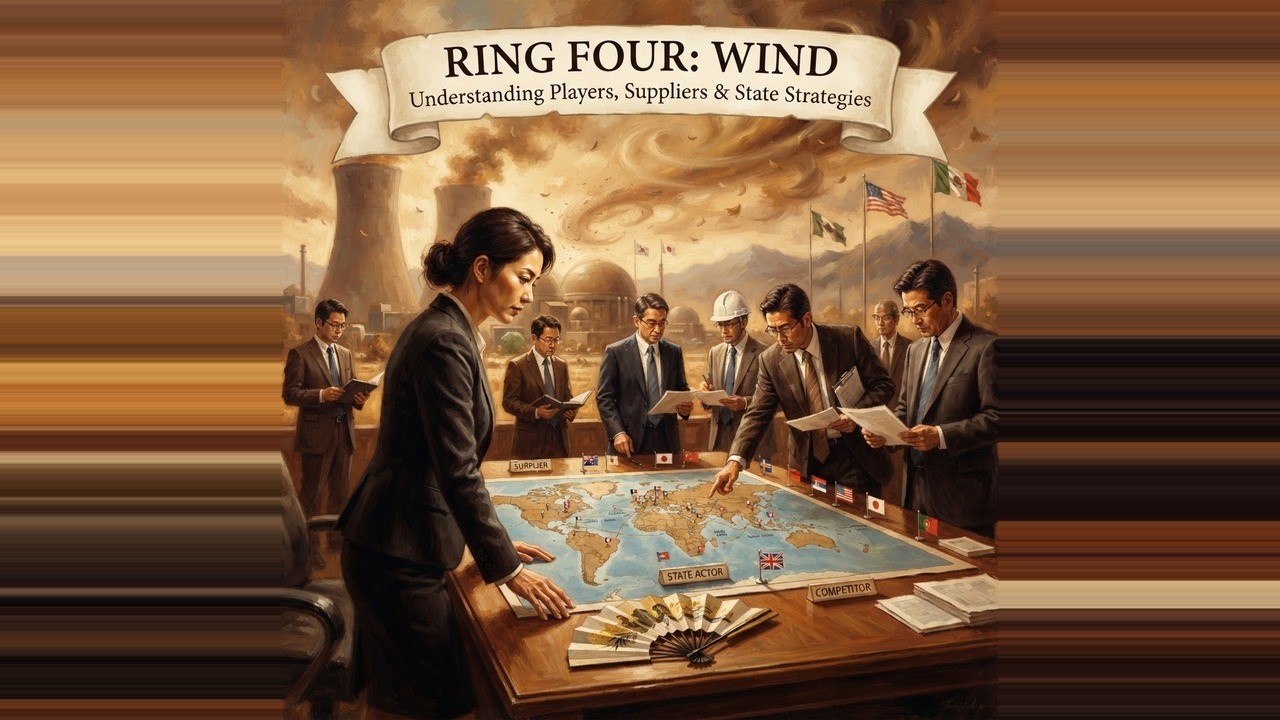
In Musashi's framework, Wind is the ring of understanding other traditions. Not to imitate them, and not to dismiss them — but to know them so completely that their strengths and their limitations become visible. Musashi wrote that if you do not understand the methods of others, you cannot understand your own.
For nuclear fuel procurement executives, Wind is the discipline of knowing how the other side thinks.
Not the supplier you are negotiating with today. The entire landscape of approaches — the sovereign-controlled producers, the private juniors, the trading houses, the sovereign wealth funds, the financial intermediaries — each operating from a different tradition, a different incentive structure, and a different time horizon.
The Sovereign Producer
Consider the producers. The dominant Central Asian producer is a sovereign-controlled entity operating within a national strategic framework. Its production decisions are not purely commercial. They reflect resource conservation policy, bilateral diplomatic commitments, and the long-term positioning of the state. A procurement executive who models this producer as a rational profit-maximizing supplier has misunderstood the counterparty. You are not negotiating with a company. You are negotiating with a sovereign interest that has chosen to sell uranium as one instrument among many.
The Chinese Integrator
The Chinese model is different again. Chinese nuclear entities are building vertical integration across the entire fuel cycle — mining, conversion, enrichment, and fabrication — under a unified state strategy. Chinese conversion and enrichment capacity is expanding rapidly, but it serves a domestic reactor fleet first. The procurement executive who looks at Chinese capacity additions and sees surplus supply available to Western markets has misread the architecture. That capacity exists to serve Chinese energy security, not to relieve Western tightness.
The Russian Bundler
The Russian approach is perhaps the most instructive, because it is the one Western utilities understand least. Russia has historically offered bundled fuel cycle services — uranium, conversion, and enrichment in a single package — at terms that were competitive precisely because they were integrated. The Russian provider was not selling three separate commodities. It was selling a strategic relationship, and the pricing reflected the value of that relationship to both parties. Western utilities that are now working to replace Russian supply are discovering that the alternative is not three separate contracts. It is the reconstruction of an integrated supply chain from scratch, and the cost of that reconstruction is the true price of dependency that was never priced in.
The Western Tradition
The Western producers and service providers operate from yet another tradition. The major Western uranium producers are publicly traded companies answering to shareholders, operating under regulatory regimes that impose costs their state-owned competitors do not bear. Western conversion and enrichment companies are rebuilding capacity that was idled when the market did not justify its operation — and they are rebuilding it in a regulatory and capital environment that is slower, more expensive, and more uncertain than the environment in which the original capacity was built. The Western executive who expects domestic capacity to arrive on the timeline of a private balance sheet decision has not accounted for the regulatory layer.
The Intermediaries
And then there are the intermediaries — the trading houses, the physical brokers, the financial institutions that have entered the uranium market as both liquidity providers and positional actors. Some of these entities are acquiring physical material. Some are offering structured procurement products. Some are holding inventory that influences the price discovery process. The procurement executive who treats the trading layer as transparent and neutral is operating with a model of the market that no longer matches the market's structure.
Knowing the Other Schools
This is what Musashi meant by knowing the other schools. Each participant in the nuclear fuel market operates from a different tradition — a different set of incentives, constraints, time horizons, and strategic objectives. The state-owned producer does not think like the private miner. The Chinese integrator does not think like the Western utility. The Russian bundler does not think like the commodity trader. And the trader does not think like any of them.
Wind is the discipline of mapping these traditions so that your procurement strategy accounts for how each counterparty will actually behave — not how you would behave in their position, and not how a textbook model predicts they should behave. It requires intelligence: on production trajectories, on capacity investment plans, on bilateral agreements that may redirect supply before it reaches the open market, on the financial health of producers whose output you are counting on, and on the political dynamics that can redirect a nation's uranium policy without warning.
Most procurement organizations do not invest in this discipline. They maintain supplier relationships, they track published price indices, and they engage brokers who aggregate market color. But they do not build a structured understanding of the competing traditions operating across the fuel cycle. They know their suppliers. They do not know their suppliers' suppliers. They know the price. They do not know the forces behind the price.
The procurement executive who has mastered Earth, Water, and Fire — who has built the foundation, developed the adaptability, and seized the initiative — but who has not studied Wind, will find that the initiative is short-lived. You can move first and still be outmaneuvered by a counterparty whose incentives you did not understand, whose time horizon you did not model, and whose next move you did not anticipate because you were looking at the market through your own tradition alone.
Musashi wrote: "You must study the methods of other schools. By knowing them, you will see the true way of your own."
In nuclear fuel procurement, the true way of your own strategy is visible only when you have mapped the traditions of everyone else at the table.

