Ring Two — Water: Adaptability, Flow, and Strategic Flexibility
Musashi writes that Water takes the shape of its container. It teaches fluidity — the ability to shift stance, tempo, and method without losing identity. For U.S. nuclear utilities, this principle should stand out as foundational, as fluidity translates into operational longevity.
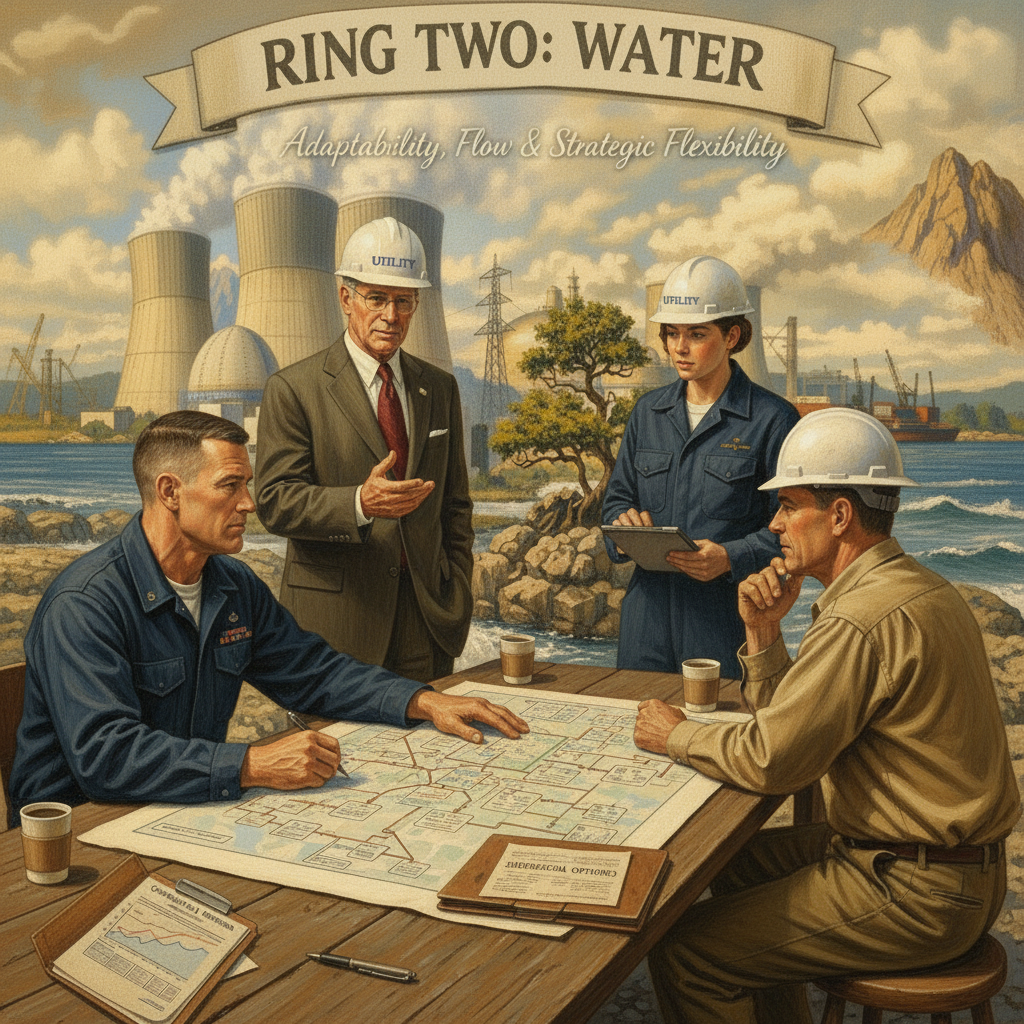
As we proceed to digest The Book of Five Rings, Musashi writes that Water takes the shape of its container. It teaches fluidity — the ability to shift stance, tempo, and method without losing identity.
For U.S. nuclear utilities, this principle should stand out as the foundational, as fluidity translates into operational longevity.
1. Flexible Contracting — The Discipline of Optionality
In the nuclear sector, resilience isn't luck — it's engineered through Contractual Optionality. Utilities that maintain multiple, pre-qualified pathways for enrichment, conversion, and fabrication aren't just hedging risk; they're building strategic elasticity into their supply chain. This elasticity depends on access to superior energy intelligence — granular insight into global fuel flows, sanctions exposure, and capacity bottlenecks — and on procurement teams capable of interpreting that intelligence with nuance.
The most resilient utilities treat their contract management departments not as administrative functions but as strategic command centers — integrating commercial foresight, geopolitical awareness, and technical fluency. In a world where supply lines can shift overnight, Contractual Optionality is the operational expression of Musashi's Water: fluid, adaptive, and always ready to take the shape of the moment.
2. Scenario-Fluid Risk Posture — Intelligence as Infrastructure
Musashi's Water doesn't resist; it anticipates — and anticipation demands intelligence. Modern nuclear risk modeling must evolve from static disruption mapping into a living intelligence architecture, built through frequent industry engagement, best-in-class consulting partnerships, and insurance-based outcome modeling.
Resilience now depends on how well utilities synthesize external insight with internal awareness — how procurement, risk, and executive leadership exchange information bottom-up and top-down. This is where the earlier Trident Maor analysis becomes decisive: the call to build professional bridges between procurement teams and Big Nuclear leadership.
When those bridges exist, intelligence flows freely — contracts become instruments of foresight, not reaction. The result is a utility that doesn't just survive volatility; it reads the current before the tide turns.
3. Adaptive Workforce Strategy — Talent as a Crisis-Ready Force Multiplier
Water flows through every crevice of its environment — and so must a modern utility's talent strategy. Building a crisis-resilient workforce requires more than cross-training and modular outage teams; it demands a dual-sourced talent pipeline that draws strength from within and without the organization.
The internal side is familiar: developing operators, engineers, procurement specialists, and analysts who can flex across functions and redeploy with precision. But the external side is where many utilities still leave resilience on the table. The retired servicemember community remains one of the most underutilized strategic assets in the energy sector — a population defined by discipline, mission clarity, crisis conditioning, and an instinctive understanding of chain-of-command communication. These individuals don't just fill roles; they stabilize systems.
To accelerate readiness, utilities should integrate best-in-class intelligence firms directly into onboarding — not as optional seminars, but as mandatory crash-course immersion. When new hires begin their careers with exposure to geopolitical risk mapping, supply-chain intelligence, sanctions forecasting, and scenario-based operational modeling, they enter the workforce already calibrated to the realities of a global nuclear ecosystem.
This approach only works when information flows bottom-up and top-down. Procurement teams, risk analysts, operators, and executive leadership must share intelligence continuously — a principle echoed in Trident Maor's earlier analysis on building professional bridges between contract managers and Big Nuclear decision-makers. When those bridges exist, workforce adaptability becomes more than a staffing model; it becomes a living system capable of expanding, contracting, and redeploying with the same fluid mastery Musashi attributes to Water.
Water Principle for Utilities
Move with the world as it is, not as you wish it to be.
This is the antidote to legacy-era procurement habits that assume stability. Musashi's Water reminds us that rigidity is not strength — it's fragility disguised as control. The future belongs to utilities that can flow, adapt, and reshape without losing their core identity: safe, reliable, carbon-free baseload power.
Musashi's Water reminds us that adaptability isn't weakness — it's mastery. As the global nuclear ecosystem reshapes itself through new alliances, sanctions, and supply-chain realignments, the question becomes: how fluid is your organization's stance?
I invite colleagues across utilities, fuel cycle firms, and policy circles to share how they're building strategic flexibility into their operations — whether through contract diversification, workforce adaptability, or scenario-based risk modeling.
We must make "flow" more than a metaphor — let's make it a strategic discipline for the next era of U.S. nuclear leadership!

